


Unforgiven - The Assassination of the Western Genre
*Spoilers for Unforgiven*
The Western, as a genre, has existed for well over a century. The genre is perhaps the closest thing American culture has to a mythology. The genre was defined by films, like Shane (1953), that tell stories of violent men attempting to outrun their rough and rowdy past. After several decades, just when this story seemed so tired and overdone, Clint Eastwood released the western to end all westerns – Unforgiven (1992). This film is a much darker and more violent look at the western mythos, and purposefully subverted many of its notable tropes. Unforgiven uses sadistic characters and a brutally honest look at the western to critique the modern anti-hero and the glorification of violence in America.
The film illustrates this point through a few key characters. The first is Clint Eastwood’s character and the main protagonist of the film, William Munny. A former outlaw, Munny was pulled away from crime by a woman, only for her to die a few short years later. After she has been dead for some time, Munny is recruited by a wannabe gunslinger calling himself the ‘Schofield Kid,’ to hunt down a pair of cowboys. Along the way Munny picks up his former sharpshooting companion, Ned Logan, and together the three of them track the cowboys. The cowboys have a bounty on their head for having cut up the face of a prostitute, but being let off with only a fine by the local sheriff, ‘Little’ Bill Daggett.
William Munny, is not, however, the pistoleer he once was. While practicing with his old pistol, he cannot even hit a stationary target from just a few yards away. Additionally, throughout the film Munny is haunted by the memory of his wicked deeds. When ill, he has horrible nightmares where he sees the decaying corpses of his victims. These attributes can be traced, in large part, to his sobriety. It is stated that back in the day, if Munny was full of liquor, he was a terrifying sight to behold, killing men, women, children, and anyone else who got in his way. Yet, once he found his wife, he gave up alcohol to try to be a better man.
For most of the film, Munny barely makes it along. When caught in a rainstorm, he almost immediately becomes ill. While ill, he is assaulted and beaten within an inch of his life by Little Bill. After this he is taken out of town and left to rest for several days, in which time his companions believe he may die. It is only after recovering from this that he is somewhat able to perform his work, using Ned’s rifle to shoot one of the cowboys from a cliff.
It is only at the end of the film, after giving in and becoming extremely intoxicated, that he lives up to his reputation. After the Kid kills the second cowboy, Ned is arrested by Little Bill, and beaten to death. Upon hearing this news, Munny sends the Kid away, drinks all the whiskey he can find, and marches into the saloon where Bill is forming a posse to hunt him. After a moment of suspense, Munny guns down half the men in the building, and sends the rest out with their tails between their legs.
This gunfight is unlike those in classic westerns like Shane (which this fight is heavily reminiscent of). There is no glory. The scene does not leave the audience applauding the violence, or satisfied by any moral victory for the protagonist. It is dark, somber, and above all, senseless. William Munny kills all those men for nothing more than pure revenge. He exits the story as a worse man than when it began.
The second character the film uses to make its point is the Schofield Kid. The Kid is, above all else, obnoxious. He is arrogant, loud, and generally unpleasant. It is woefully apparent how insecure he is in his own ability as an outlaw. This is further worsened by the reveal that he has terrible vision, unable to see anything more than a couple dozen yards away. It is revealed that the real reason he is seeking this bounty is to raise enough money to get a pair of glasses, so that he can see properly.
The film makes a point to juxtapose Munny, the murderer plagued by nightmares of his killings, with the Kid, who claims to have killed 5 men, but really, he has killed none. The Kid has heavily romanticized the life of a gunfighter. He sees a life of crime in the West as it was portrayed in film for so long – an adventure. He frequently prods Munny to recount his stories of cruelty, but Munny has no interest in sharing.
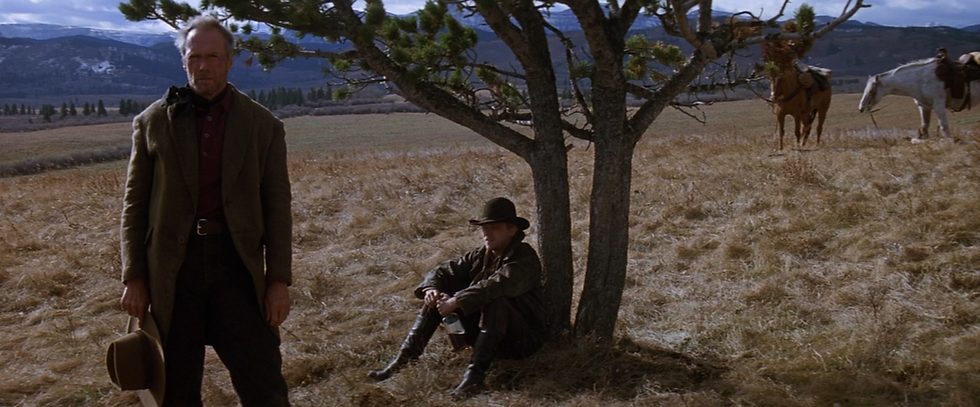
The Kid finally gets all he ever wanted when he guns down the second cowboy. He catches his victim off guard, while he is in an outhouse, and hesitates long enough to hear the cowboy plead for life, but he guns him down anyways. After he and Munny escape, he sits by a tree and waits for his bounty to be brought to him. While he sits, he recounts the killing to Munny. At first, he feigns excitement for having finally killed a man, but quickly drops the façade and reveals how much he is hurting. He breaks down crying upon realizing what he has truly done. William Munny sums up what it is like to kill a man – “You take away everything he's got and everything he's ever gonna have.”
The Kid has the mindset of so many young people who grew up on watered down violence. He is taught from a young age that a real man is a killer, and ferocity is the most important trait a man can have. In the end, though, he is forced to reconcile with the truth of the matter – the only gunfight you truly win is the one you avoid. When Munny asks to use his Schofield revolver, the Kid hands it over and says he is never going to use it again.
The third character is one that taps directly into the metanarrative of the film: the writer, W. W. Beauchamp. Beauchamp enters the film accompanying a gunslinger named English Bob. He is there to write the biography of the British pistoleer. English Bob is there to kill the cowboys, just like William Munny and his crew. Beauchamp swiftly discovers that Bob is not who he presents himself as. Little Bill beats Bob within an inch of his life and throws him in jail. While Bob is in the cell, Little Bill tells Beauchamp the truth about his companion. He tells of how cowardly Bob really is, and dispels all myth of him being a deadly gunslinger.
Yet, Little Bill is his own kind of contradiction. More than once in the film, Bill calls someone else a coward for attacking an unarmed man, yet every armed encounter he is in (with the exception of the final shootout) plays out the exact same way: Bill gathers his deputies and uses superior numbers and fire power to surround his opponent, he forces his opponent to surrender their weapons, and when he has disarmed them, he then proceeds to viscously beat them, sometimes until they die. Though Bill presents himself as the morally upright hero, he is as much of a self-indulgent, violent coward as English Bob.
Beauchamp, however, does not recognize this hypocrisy and turns his attention from Bob, who is sent away on the next train, to Little Bill. He continues to ask Bill questions about gunfighting right up until Little Bill is gunned down by William Munny. Instead of being properly scared or horrified by seeing so much death so quickly, Beauchamp is enamored by the ruthless outlaw that has just killed six men. He tries to question Munny the same way he questioned Bill and Bob, but Munny simply threatens to kill him and runs him out.
Beauchamp’s character is, essentially, a stand-in for the western audience. He knows all the tropes and archetypes of typical westerns. Unlike the Kid, who is obsessed with living the life of an outlaw, Beauchamp approaches this lifestyle as an outsider, someone who only truly cares about the stories. To him, it is just that – stories. Beauchamp wants to show the truth about the Wild West, but is shown, every step of the way, that he has no idea what the truth is about the West. Every preconceived notion he has about the west is immediately destroyed by those who truly live that life. First by Bill, who simply tells him he is wrong, and second by Munny, who shows him very explicitly.
Unforgiven is the only traditional western (one with cowboys and gunslingers) to have ever won the Academy Award for Best Picture. It is one of the most important films in the western canon. It is, essentially, the death of the traditional western. Since its release, westerns as a genre have not been the same. All westerns since 1992 have either been throwbacks, designed to emulate classic westerns, like Tombstone (1993), or post-westerns, tackling many of the same complicated themes as Unforgiven, like The Assassination of Jesse James by the Coward Robert Ford (2007).
The latter of these, as well as more recent and niche films like The Kid (2019), ask the same question that Unforgiven asked almost 30 years ago – why do Americans idolize such violent people? Jesse James, Billy the Kid, Bonnie and Clyde, all terrible and violent murderers, and yet they are all presented as American Folk heroes. Unforgiven shows the true nature, not only of these terrible men, but of the clueless fools, like Beauchamp, who make them into legends.

Comments