


The Batman - Becoming More Than Vengeance
Batman, of all comic book heroes, has perhaps the most peculiar history of on-screen adaptations. The character has had four "dark and gritty" live-action franchise reboots in thirty-three years, with each supposedly being darker than the last. Tim Burton's 1989 Batman achieves this by simply taking it self more seriously than Adam West's version and creating a truly atmospheric Gotham city, Christopher Nolan's Dark Knight Trilogy creates a Gotham that could more plausibly exist with a masked vigilante running the streets, and Zack Snyder's Batman v Superman presents an older, broken, and more violent version of the character.
Matt Reeves new film, The Batman, does a little bit of all three. Like Burton, this Gotham is very unique and stylistic (and much more distinct than Nolan's Gotham, which was mostly just the city of Chicago). Like Nolan, his Batman exists in a grounded world, which feels so much more like our own world than the MCU or DCEU (this is not a world where Batman would likely meet Superman, Wonder Woman, or The Flash).
Of the three prior adaptations, however, I would assert that The Batman has the most in common with Zack Snyder's version, at least in regards to the character arc and development of Bruce Wayne. Both adaptations approach the character as imperfect or incomplete characters. In Batman v Superman, Batman is old, cynical, and jaded. He has forsaken much of what makes him Batman, and the story of the film culminates in his realization of who Batman should be, and the beginning of his redemption arc.
Matt Reeves presents the perfect equal/opposite to this. His Batman is young, inexperienced, and unsure of who Batman should be. Like Snyder's version, he does not exactly fit the general idea of who Batman should be. Throughout the film, though the name "Batman" is used, no one directly addresses him as such. He is only ever named as "Vengeance" (a title that calls back to the famous Kevin Conroy line, "I am Vengeance, I am the Night, I am Batman!"). This small detail is symbolic of the films notion that Bruce Wayne is not quite yet fully Batman. Two years into his time as a vigilante, and he is simply Vengeance, nothing more and nothing less.
This Batman is brutally violent, unrelenting, and genuinely unhinged. One of the more unique aspects of this adaptation is its focus on presenting Batman as genuinely unwell. He is obsessive and disconnected. Part of this is related to a common half-baked critique of the movie I have heard repeatedly that argues that this movie makes no distinction between Batman and Bruce Wayne. They are right, but that is the point. He is still learning how to be Batman. He is not using using his vast wealth to truly help those in need, merely take revenge on those who do wrong. This story is about him learning that Bruce Wayne has to exist as his own entity, and that Batman must be more than Vengeance. In this way he is similar to Snyder's Batman, as he is a character we watch overcome his flaws and weaknesses to become the Batman he was always meant to be.
The main villain of the film, The Riddler, is flawlessly executed. Paul Dano perfectly portrays the cold and calculated serial killer iteration of the character. If we were to use the Five Point Villain Ranking Scale,* Riddler would get a perfect score. He is Dangerous, connected to the hero, sympathetic, yet detestable, and has an unforgettable presentation. In addition to being an amazing villain, his story serves the narrative of the film, specifically surrounding the theme of Vengeance, incredibly well.
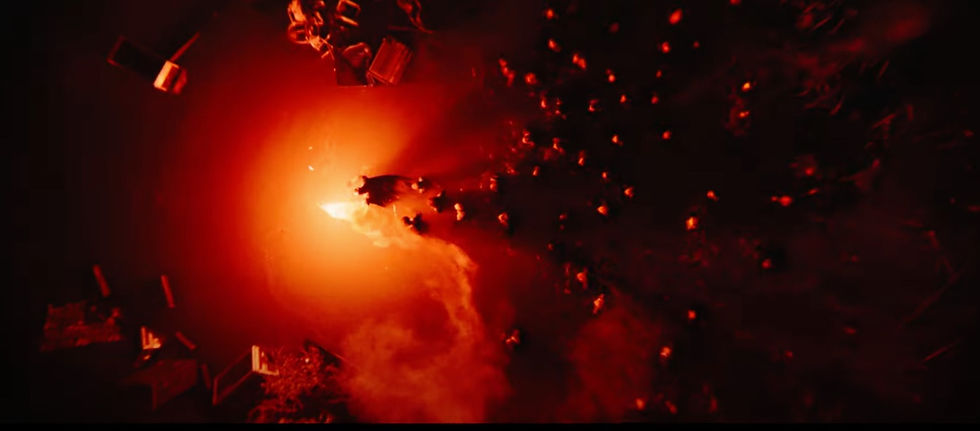
Visually, this is not only the most stunning Batman movie, not only the most stunning superhero movie, but also, I would argue, truly one of the most beautifully shot films ever. The use of color is immaculate and the use of darkness and shadows is ominous and foreboding. The film makes excellent use of a number of POV shots that make the action feel so intimate. When it comes to scenes involving The Riddler, the film expertly designs shots that are purposely out of focus. This creates a heightened sense of mystique and suspense around a villain that is already haunting to begin with. If this film does not win awards for cinematography, than cinema awards are truly pointless.
*** SPOILERS BEGIN ***
The largest departure The Batman makes from previous iterations is the films treatment of the Wayne family legacy. In all previous versions (barring Todd Phillips' Joker) Bruce Wayne's parents, or more specifically his father, Thomas Wayne, is presented as a good, honest, morally incorruptible, and all-around flawless individual. This legacy of philanthropy and charity has always been one of the things that has driven Bruce to become a hero.
Matt Reeves challenges this notion by creating a scandal surrounding Thomas Wayne. Just as Thomas Wayne announces his candidacy for Gotham Mayor, a reporter digs up Martha Wayne's family history of mental illness. In an attempt to silence him, Thomas approaches mob boss, Carmine Falcone, who has the reporter killed. Falcone asserts that the reporter worked for Falcone's rival, Salvatore Maroni, and that it was Maroni who likely had the Wayne's killed. Alfred asserts that Thomas made a mistake, but didn't mean for the reporter to be killed, and when he threatened to go to the police, Falcone had him killed. Both stories have some level of doubt cast on them, and it is still entirely possible that it was just a random mugging gone wrong.
No matter what story the viewer chooses to believe, one thing is clear - Thomas Wayne made a huge mistake. This revelation, followed immediately by Alfred's apology to Bruce for not being able to be a real father to him, highlights the films focus on trauma and, as Riddler calls it, "The Sins of the Father." Bruce Wayne growing up without a solid father figure is an important aspect of how he ends up the kind of shattered soul that would take up the mantle of Batman. While trying to make Gotham a better place, Bruce must wrestle with the failures of his father figures, both alive and deceased. Bruce must endure, as all people eventually do, the realization that his parents were not perfect, and must decide if he will reject them for that, or accept that they, like he, are merely human, and will sometimes fail. This is what makes Matt Reeves Batman more real, vulnerable, and relatable than any Batman prior.
*** SPOILERS END ***
The Batman stands head-and-shoulders above most, if not all, superhero movies to be released prior. It tells a complicated story that juggles numerous characters and plot lines, yet the story feels deeply personal and focused around its central themes. Regardless of whether you like comic books or not, whether you like the MCU, DCEU, perfer the Snyder films, or don't really watch movies at all, everyone should see The Batman.
*Five Point Villain Ranking Scale created by @DreadPirateDad on TikTok

Comments